The Best Rock Songs in 12/8 Time (A Guide to the Triplet Groove)

Introduction
While the vast majority of popular music operates within a standard 4/4 time signature, the rock genre frequently demands a different rhythmic foundation to convey specific emotional weights. When a rock band requires a heavy, dragging blues swing, a sprawling atmospheric ballad, or a crushing doom-metal riff, composers frequently shift to the 12/8 time signature.
This mathematical framework provides the legendary “triplet feel,” allowing the rhythm section to maintain a massive, steady pulse while the melodic instruments articulate in rapid, cascading patterns. Analyzing rock songs in 12/8 provides invaluable insight into how tempo and subdivision manipulate the psychological impact of a track.
Key Takeaways of the Article
- The 12/8 time signature divides four main beats into three sub-beats each, creating a distinct rolling or swinging momentum.
- Legendary 12/8 time signature songs rely on this groove to build everything from acoustic ballads to thrash metal anthems.
- Guitarists heavily favor 12/8 for arpeggiated picking patterns and traditional blues-scale soloing.
- Setting up a modern Digital Audio Workstation (DAW) for a 12/8 rock groove requires specific grid and Track Control Panel adjustments to ensure accurate MIDI recording.
What Makes 12/8 Time So Powerful in Rock?
To understand the power of the 12/8 rock groove, one must examine the fundamental music theory underlying the mathematics. In a 12/8 framework, there are twelve eighth notes in a single measure. However, these notes are not counted individually as a rapid sequence of twelve. Instead, they are grouped into four primary pulses. Each of these four pulses contains three eighth notes (a triplet).
The counting mechanism is traditionally vocalized as: 1-and-a, 2-and-a, 3-and-a, 4-and-a.
This creates a hybrid effect: the listener headbangs or taps their foot to the four primary macro-beats, but the microscopic groove of the song swings in triplets.
Point of Interest
For producers and musicians looking to fully master the mechanics of this rhythm, reviewing a comprehensive breakdown of the 12/8 time signature is highly recommended.
Iconic Rock & Metal Songs in 12/8 Time
Analyzing historical rock songs in 12/8 time reveals how versatile this rhythmic framework can be across subgenres.
Metallica – “Nothing Else Matters”
Arguably the most famous metal ballad ever recorded, this track is a masterclass in 12/8 arrangement. The song opens with an acoustic guitar playing an open-string E minor arpeggio that cascades naturally. The 12/8 signature allows the arpeggiated notes to cascade naturally, providing a rolling, uninterrupted flow. The time signature grants the track its melancholic, waltz-like cadence that a rigid 4/4 structure could never achieve.
Led Zeppelin – “Dazed and Confused”
This track is the quintessential example of the heavy, dragging blues-rock swing. John Bonham’s legendary drum groove relies heavily on the triplet subdivision to create a swampy, delayed snare impact. The 12/8 time signature here feels massive and threatening, perfectly complementing Jimmy Page’s descending, doom-laden bassline riff.
The Animals – “House of the Rising Sun”
A foundational pillar of classic rock, this track features an iconic chord progression played entirely as arpeggiated chords in 12/8. The guitarist plays a continuous stream of eighth notes, allowing the triplet grouping to naturally guide the listener through the minor-key storytelling of the vocals.
Pink Floyd – “Shine On You Crazy Diamond” (Part VIII)
Progressive rock acts frequently utilize 12/8 to establish cinematic, atmospheric landscapes. In Part VIII of this multi-part epic, the band locks into a slow, deliberate 12/8 groove. The triplet spacing provides David Gilmour’s lead guitar lines with vast amounts of sonic breathing room, turning a traditional blues format into a sweeping, space-rock odyssey.
Megadeth – “In My Darkest Hour”
The 12/8 time signature is not reserved exclusively for slow ballads. In thrash metal, bands use it to create a galloping, bouncing aggressive riff. Dave Mustaine utilizes the triplet subdivision to palm-mute complex power chord progressions, proving that a 12/8 rock groove can be incredibly hostile and driving at higher tempos.
Why Guitarists Love the 12/8 Time Signature
When viewing the composition process from the perspective of an instrumentalist, guitarists naturally gravitate toward 12/8 time signature songs for several technical reasons:
- Arpeggiation: The 12-beat subdivision aligns perfectly with six-string guitar mechanics. Playing two strings per sub-beat or sweeping across all six strings fits the mathematical grid perfectly.
- Alternate Picking: The rolling nature of the triplet allows for smooth, continuous up-and-down alternate picking without jarring rhythmic resets.
- The Blues Shuffle: The pentatonic scale licks that form the basis of rock guitar solos were originally born from the 12/8 blues shuffle. Playing a solo over this time signature feels inherently natural to any guitarist trained in traditional rock phrasing.
12/8 vs. 6/8: What is the Difference in Rock?
A common point of confusion for beginner musicians and producers is distinguishing between 12/8 and 6/8 time. While both are compound meters based on triplets, their application in a rock context differs drastically in how the drum kit is programmed.
| Feature | 12/8 Time Signature | 6/8 Time Signature |
| Primary Pulses | Four distinct beats. | Two distinct beats. |
| Rock Snare Placement | Falls on the 4th and 10th eighth notes (Beats 2 and 4). | Usually falls on the 4th eighth note. |
| Overall Feel | A colossal, driving rock anthem or heavy swing. | A swaying, maritime waltz or fast punk beat. |
| Song Example | “Dazed and Confused” (Led Zeppelin) | “We Are the Champions” (Queen) |
How to Record 12/8 Song in DAW
When recording these complex triplet rhythms in a modern studio, software preparation is mandatory. If an engineer attempts to record a 12/8 rock groove into a DAW set to a standard 4/4 grid, the metronome will clash with the performance, and MIDI quantization will ruin the swing.
To prepare the workspace for tracking:
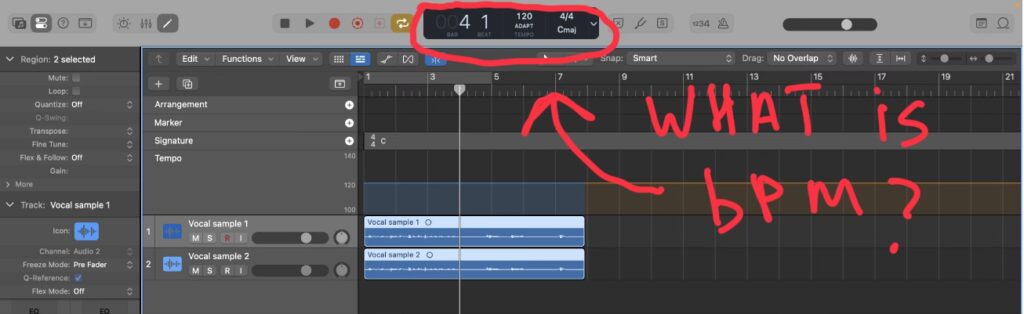
- Navigate to the project tempo settings.
- Adjust the Time Signature denominator and numerator.
Project Settings -> Timebase -> Set Time Signature to 12/8
- Open the Track Control Panel (TCP) for the drum recording track.
- Adjust the grid snap settings to reflect the new compound meter.
Grid Options -> Snap to Grid -> Set to 1/8 Triplet (1/8T)
- In the Mixer window, group the drum bus and ensure the faders have adequate headroom, as the dense triplet kick drum patterns common in 12/8 rock require significant low-end management to avoid clipping.
Conclusion
The 12/8 time signature remains one of the most vital compositional tools in the history of rock and metal. By grouping twelve eighth notes into four heavy pulses, bands can unlock a rhythmic pocket that standard common time simply cannot replicate. From the acoustic sorrow of Metallica to the thundering blues of Led Zeppelin, understanding the 12/8 rock groove is essential for any producer or musician looking to inject authentic weight, swing, and cinematic atmosphere into their tracks.
FAQ
No. While they both contain four primary pulses, the mathematics differ. In 4/4, each beat is divided into two even eighth notes. In 12/8, each beat is divided into three eighth notes (a triplet), completely altering the physical groove and swing of the rhythm.
Absolutely. Because the time signature features four primary downbeats per measure, the listener naturally nods or headbangs on those four main pulses, just as they would in a standard 4/4 metal track, while the guitars play the faster subdivisions.
While tempos vary, a standard 12/8 rock ballad or heavy blues track typically sits between 50 BPM and 75 BPM. This slower pace allows the triplet notes to breathe, maximizing the heavy, dragging impact of the drum kit.