When Was Auto-Tune Invented? The 1997 Discovery That Changed Music Forever
In the landscape of modern music production, few tools are as ubiquitous—or as controversial—as pitch correction software. It shapes the vocals of pop stars, rappers, and indie artists alike. Yet, the origins of this technology are often misunderstood. Questions like “who invented auto tune?” and “when did autotune come out?” reveal a fascinating intersection of geological science and audio engineering.
This guide explores the history of autotune, tracing its timeline from seismic data processing in the oil industry to its release in 1997 and its subsequent domination of the Billboard charts.
Introduction
When was autotune invented? The technology was officially released in 1997 by Antares Audio Technologies. However, the mathematical foundation behind it was developed years earlier for a completely different purpose.
Auto-Tune is a proprietary audio processor that measures and alters pitch in vocal and instrumental music recording and performance. Originally designed to subtly correct off-key notes, it has evolved into a creative instrument in its own right. Understanding when was autotune created requires looking at the career of a specific research engineer who made a pivotal pivot from geophysics to music.
The Inventor: Who is Dr. Andy Hildebrand?
To answer who invented autotune (and who created autotune), one must introduce Dr. Andy Hildebrand. Surprisingly, Hildebrand was not a music producer by trade, but a Ph.D. graduate in electrical engineering specializing in digital signal processing.
From Oil Fields to Audio
Before revolutionizing music, Hildebrand worked for Exxon.
- Seismic Data: He developed complex algorithms to analyze seismic waves sent deep into the earth.
- Autocorrelation: By analyzing the reflections of these waves, his software could map underground structures to locate oil deposits.
- The Pivot: Upon retiring from the oil industry, Hildebrand realized that the same mathematical principle (autocorrelation) used to detect geological data could be used to detect the pitch (frequency) of an audio signal.
This realization is the cornerstone of autotune history. The algorithm does not “hear” music; it detects periodic repetitions in a waveform, similar to how it detected layers of rock.
1997: The Launch at NAMM
When auto tune was invented as a commercial product, it debuted at the NAMM (National Association of Music Merchants) show in 1997.
The Initial Reception
Released as a plug-in for Pro Tools and as a standalone rackmount unit (ATR-1), the technology was an instant success among recording engineers. However, it was shrouded in secrecy.
- The “Secret Weapon”: In the late 90s, studios used it to fix vocal imperfections without the listener knowing. It was designed to be transparent.
- Workflow Change: Before 1997, fixing a bad note required re-recording the take or physically splicing magnetic tape. Auto-Tune allowed for real-time, non-destructive correction.
At this stage, who popularized autotune was not a specific artist, but rather the engineering community who used it as a corrective utility.
What was the first song to use Auto-Tune?
While many songs used it subtly, the first song to openly weaponize the effect was Cher’s 1998 hit, “Believe.”
- The Accident: Producers Mark Taylor and Brian Rawling discovered that by turning the “Retune Speed” parameter to zero (instant), the software did not gently slide the pitch to the correct note. Instead, it snapped the audio instantly, creating a robotic, stepped effect.
- The Cover-Up: Fearing that other producers would steal the trick, the production team initially lied to sound engineering magazines, claiming the effect was achieved using a vocoder (a different technology entirely).
“Believe” marks the moment in autotune history where the software transitioned from a “fixer” to an “effect.”
The Evolution of the Robot Voice
After the success of “Believe,” the usage of the tool exploded. The question of who popularized autotune shifts from engineers to specific artists who defined their sound with it.
- The T-Pain Era (Mid-2000s): Rapper and singer T-Pain built his entire career around the “hard-tuning” effect. He utilized it not to hide mistakes, but to turn his voice into a synthesizer-like instrument.
- Kanye West (2008): With the album 808s & Heartbreak, West utilized Auto-Tune to convey emotional vulnerability, proving the tool could be artistic rather than just robotic.
- Modern Trap (2015-Present): In modern hip-hop (Future, Travis Scott, Migos), Auto-Tune is as essential as the drum beat. It is no longer a question of when did autotune come out, but rather how heavily it is applied.
How Does Auto-Tune Actually Work? (Simplified)
To understand what was the first song to use autotune effectively, it helps to understand the parameters that Dr. Hildebrand designed.
The core interface consists of two main controls:
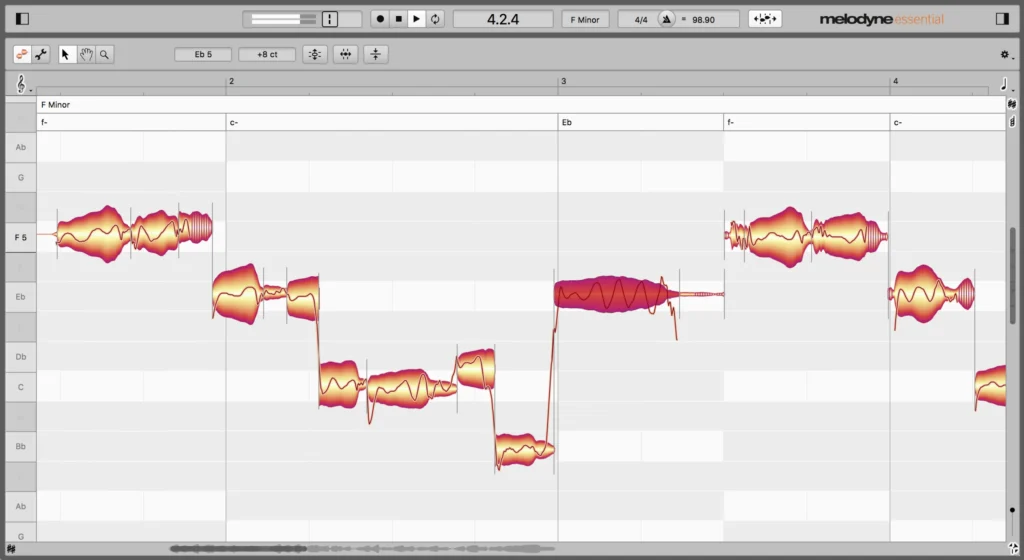
- Key and Scale: The user defines the musical key (e.g., C Major). The software discards any notes that do not belong to this scale.
- Retune Speed: This defines how quickly the software moves the pitch to the target note.
- Slow Speed (>50ms): The pitch glides naturally. Used for subtle correction.
- Fast Speed (0ms): The pitch snaps instantly. This removes the natural vibrato and slide between notes, resulting in the “Cher effect.”
Conclusion
The answer to “when was autotune invented?” is 1997, but its impact is still unfolding today. Who invented autotune? Dr. Andy Hildebrand, a geophysicist who repurposed oil exploration data to solve the problem of out-of-tune singing.
From its secretive beginnings in studio control rooms to its blatant use in global pop hits, Auto-Tune has fundamentally altered how humans record and perceive the voice. Whether used for imperceptible polish or robotic texture, it remains the most significant audio invention of the last 30 years.
FAQ
Who invented Auto-Tune?
Dr. Andy Hildebrand invented Auto-Tune. He was an engineer working in the oil industry who applied seismic data analysis (autocorrelation) to audio pitch detection.
What was the first song to use Auto-Tune?
The first song to use Auto-Tune as a noticeable creative effect was “Believe” by Cher, released in 1998. However, many songs in 1997 used it subtly for pitch correction.
When did Auto-Tune come out?
Auto-Tune was officially released to the public in 1997 by Antares Audio Technologies.
Who popularized Auto-Tune in hip-hop?
A: T-Pain is widely credited with popularizing the stylistic use of Auto-Tune in hip-hop and R&B in the mid-2000s, followed by Kanye West’s influential album 808s & Heartbreak.Q: Is Auto-Tune the same as a Vocoder? A: No. A Vocoder requires a carrier signal (like a synthesizer) and a modulator (voice) to create a robotic sound. Auto-Tune processes the pitch of a single vocal track digitally without a carrier signal.