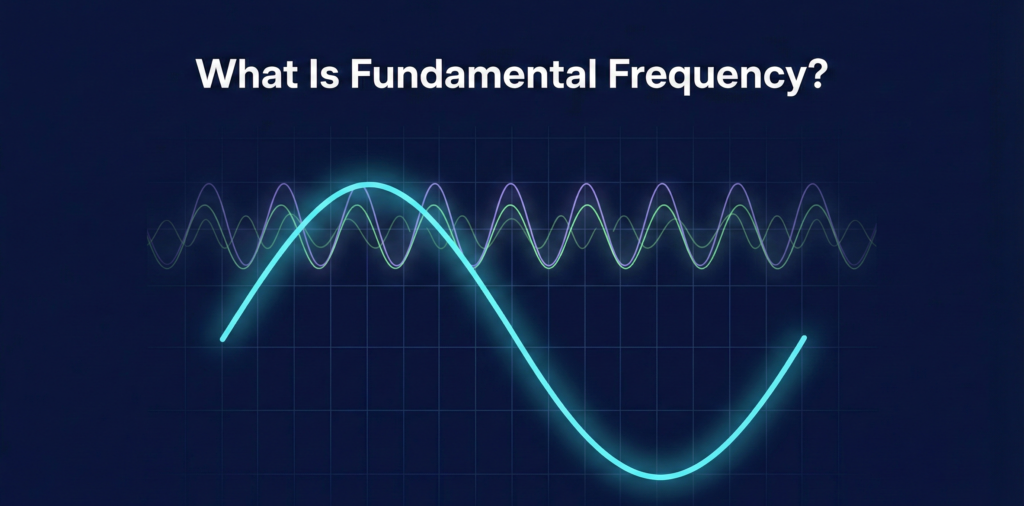
What is Fundamental Frequency? The Core of Pitch and EQ Explained
Introduction
When a listener hears a musical note, the human ear instantly recognizes its basic pitch, whether it is a deep bassline or a soaring vocal. The scientific explanation for this immediate recognition lies in a core acoustic concept known as the fundamental frequency. In audio engineering, acoustics, and physics, the definition of fundamental frequency is the lowest frequency produced by any oscillating body or periodic waveform. It is the dominant acoustic energy that dictates the perceived musical note. Understanding what is a fundamental frequency is the absolute cornerstone of professional music production, equalization, and sound design.
The Technical Definition (Physics vs. Music)
To grasp what fundamental frequency is, one must look at both the physical properties of sound waves and their musical interpretation. Sound travels in waves, and the rate at which these waves complete a full cycle per second is measured in Hertz (Hz). In physics, the fundamental frequency definition refers to the lowest sinusoidal component of a complex periodic wave. If a sound wave repeats its cycle 440 times per second, the frequency fundamental is exactly 440 Hz.
In the realm of music theory, audio professionals often ask: what is the fundamental tone? The fundamental tone is simply the musical translation of that lowest physical frequency. It is the primary Pitch that the listener identifies. For example, striking the middle A key on a piano generates a frequency fundamental of 440 Hz. While the piano string vibrates at many different speeds simultaneously, 440 Hz is the slowest, widest vibration, making it the undeniable root note of the sound.
Fundamental Frequency vs. Harmonics (Timbre)
In nature, a pure fundamental tone rarely exists alone outside of synthesized sine waves. When an instrument plays a note, it generates the main pitch alongside a series of higher-pitched vibrations. These additional vibrations are known as Overtones or harmonic frequencies.
The relationship between the fundamental frequency and harmonics is what gives every instrument its unique sonic fingerprint, known as Timbre. A harmonic frequency is a mathematical, integer multiple of the base frequency. If the fundamental pitch is 100 Hz, the subsequent harmonic frequencies will occur at 200 Hz (second harmonic), 300 Hz (third harmonic), 400 Hz (fourth harmonic), and so on.
Even if a piano and a distorted electric guitar play the exact same fundamental frequency definition, they sound entirely different. The guitar’s distortion adds dense, aggressive harmonic frequencies, while the piano produces a cleaner, softer harmonic series. The fundamental dictates the pitch, but the harmonics dictate the texture.
Why Fundamental Frequency Matters in Mixing
For mixing and mastering engineers, knowing exactly what is the fundamental frequency of every element in a track is vital for achieving a clean, professional mix. The most common mixing issues arise when multiple fundamental frequencies clash in the same area of the frequency spectrum.
When a kick drum and a sub-bass synthesizer play simultaneously, their fundamental frequencies often overlap in the 40 Hz to 60 Hz range. If these frequencies are not managed, they cause low-end masking, resulting in a muddy, indistinct mix. Audio engineers use precise equalization (EQ) to carve out space. By identifying the exact frequency fundamental of the kick drum, an engineer can apply a slight EQ cut to the bass track at that exact same frequency, allowing the kick drum to punch through without losing the musicality of the bass.
Furthermore, engineers frequently use High-Pass Filters (HPF) to remove unnecessary low-end rumble from vocals, guitars, and hi-hats. By understanding the definition of fundamental frequency, the engineer knows exactly where to place the high-pass filter: just below the lowest fundamental note of the instrument, preserving the core tone while removing unwanted noise. To see exactly where to set your high-pass filters for vocals, guitars, and drums, refer to our complete mixing cheat sheet.
How to Find the Fundamental Frequency in Your DAW
Modern digital audio workstations (DAWs) provide powerful visual tools to analyze sound. Learning how to find the fundamental frequency is a straightforward process when utilizing a spectrum analyzer.
Here is the standard procedure for how to find fundamental frequency during a mixing session:
- Insert a parametric EQ or spectrum analyzer plugin onto the track. Standard industry tools include FabFilter Pro-Q 3, Voxengo SPAN, or the native Channel EQ found in most DAWs.
- Play the audio track and observe the visual spectrum display.
- Look toward the left side of the frequency spectrum (the low-end).
- Identify the very first, most prominent peak on the graph. This leftmost, tallest spike represents the fundamental frequency.
- Hover the mouse cursor over this peak. The plugin will display the exact Hertz (Hz) value, revealing the precise fundamental pitch of the audio signal.
By repeating this process, producers can map out the fundamental frequencies of their entire arrangement, ensuring that no two bass-heavy instruments are fighting for the exact same sonic territory.
Psychoacoustics: The “Missing Fundamental” Effect
An incredibly fascinating aspect of human hearing is a psychoacoustic phenomenon known as the “missing fundamental.” Sometimes, physical limitations of playback systems (such as small smartphone speakers) prevent the actual frequency fundamental from being reproduced.
If a bassline has a fundamental pitch at 40 Hz, a small speaker cannot physically play it. However, the speaker can play the upper harmonic frequencies at 80 Hz, 120 Hz, and 160 Hz. The human brain is so adept at recognizing the mathematical spacing of fundamental frequency and harmonics that it will artificially “fill in” the missing 40 Hz pitch. The listener still perceives the correct deep musical note, even though the fundamental tone is completely absent from the physical sound waves. Audio engineers exploit this effect using harmonic enhancement plugins to make basslines audible on small sound systems.
Conclusion
Mastering the frequency spectrum is the foundation of professional audio production. The fundamental frequency is not just an abstract concept; it is the absolute anchor of musical pitch and the primary target for precise equalization. By distinguishing between the core note and its accompanying harmonics, identifying clashes in the low-end, and utilizing spectrum analyzers, engineers can transform a chaotic arrangement into a clear, powerful, and balanced mix.
FAQ
It is the lowest frequency of a periodic waveform and the primary pitch that the human ear perceives when a musical note is played.
In music theory, the fundamental tone is the root musical pitch of a sound, directly corresponding to the lowest oscillating physical frequency measured in Hertz.
To learn how to find the fundamental frequency, place a spectrum analyzer plugin on an audio track and locate the first, highest peak on the far left side of the visual frequency graph.
The fundamental frequency dictates the actual note or pitch of the sound, while the harmonic frequencies (which are mathematical multiples of the fundamental) determine the unique tone or Timbre of the instrument.