The Ultimate Synth EQ Cheat Sheet for Mixing (2026 Guide)
Quick Answer
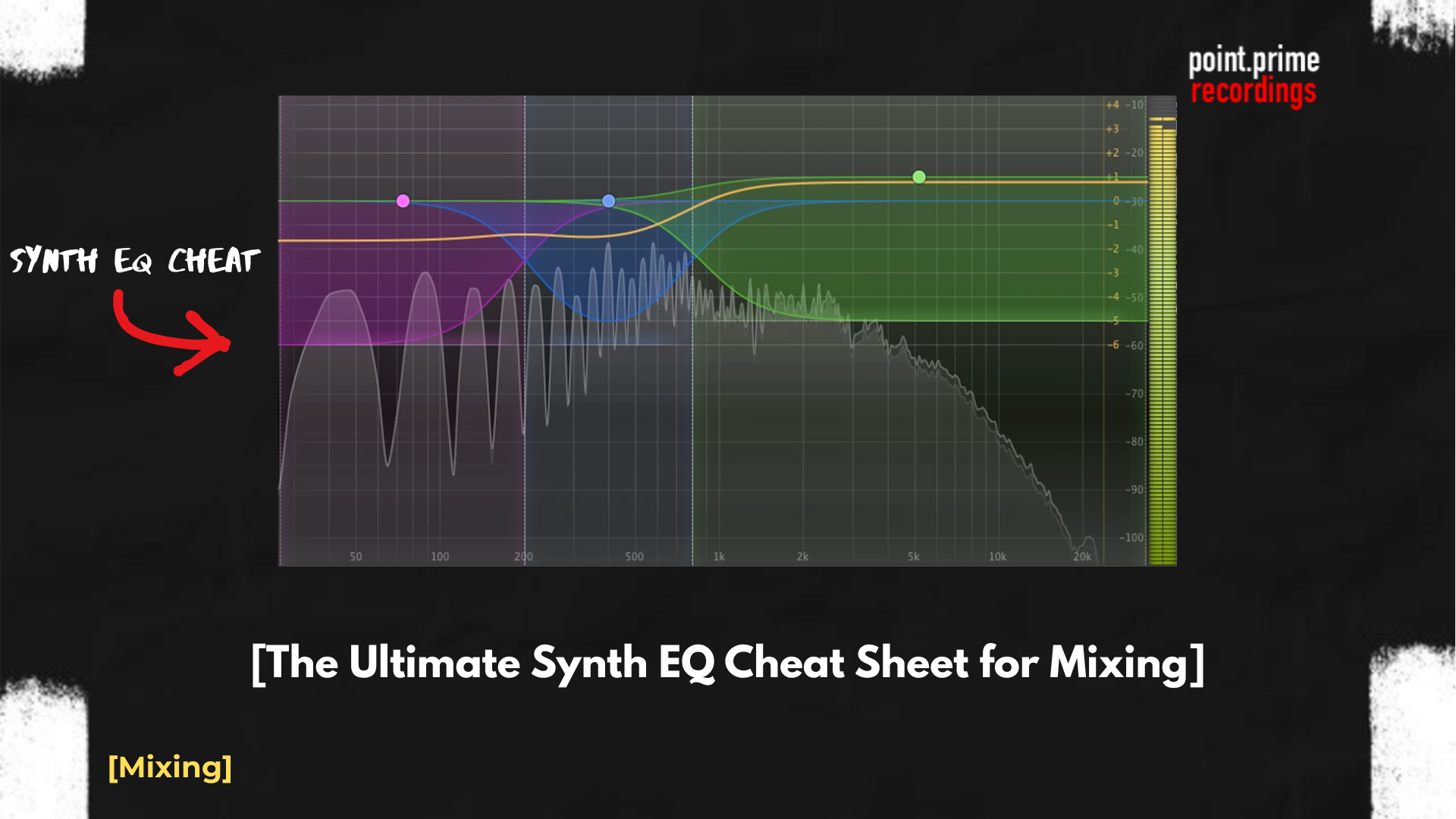
To properly process a synthesizer, an audio engineer must first identify its role in the arrangement. Apply a high-pass filter around 100Hz for leads and pads to make room for the kick and bass. Cut the 250Hz – 500Hz range to remove low-mid mud, boost 2kHz – 5kHz to add aggressive presence, and use a high-shelf boost above 8kHz to add cinematic air and width.
Introduction
Unlike traditional acoustic instruments, modern synthesizers possess the capability to occupy the entire audible frequency spectrum simultaneously. A single analog-modeled patch can generate sub-bass frequencies, warm mid-range body, and piercing high-frequency noise all at once. Consequently, mixing synths requires a highly destructive approach. If left unchecked, synthesizer layers will rapidly consume available headroom, masking the drums and burying the lead vocal. By utilizing this comprehensive synth eq cheat sheet, producers can systematically carve out space for heavy cinematic beats, ensuring clarity and punch. For a broader overview of track balancing before touching equalizers, referencing a reliable mixing cheat sheet is an essential prerequisite.
Key Takeaways of the Article
- Equalizing synthesizers is primarily a process of subtraction, aimed at removing unnecessary harmonics that conflict with the rhythm section.
- High-pass filtering non-bass synthesizers is mandatory to preserve the low-end energy required for punchy kick drums.
- Understanding synth pad eq frequencies prevents dense chord progressions from muddying the 300Hz range.
- Advanced techniques like dynamic EQ and mid/side processing allow synthesizers to sound massive without overpowering the center image of the mix.
The Synth Frequency Spectrum (Data Matrix Table)
To understand how to eq synthesizers, engineers must memorize how specific frequency bands affect the perception of synthesized waveforms. The following table outlines the foundational target areas.
| Frequency Band | Sonic Characteristic | Action to Take | Good For |
| 20Hz – 100Hz | Sub & Rumble | Cut (Unless it is a bass patch) | Removing low-end clash. |
| 200Hz – 500Hz | Mud & Boxiness | Cut -2dB to -4dB | Cleaning up dense chords. |
| 500Hz – 1kHz | Body & Warmth | Boost or Leave untouched | Adding analog thickness. |
| 2kHz – 5kHz | Bite & Presence | Boost +1dB to +3dB | Helping leads cut through. |
| 8kHz – 20kHz | Air & Sizzle | Boost with a high-shelf | Widening cinematic pads. |
Why Synths Are So Difficult to EQ
Synthesizers are notoriously difficult to place in a mix due to the mathematical perfection of their oscillators. A standard sawtooth wave does not just produce a single note; it generates a fundamental pitch and an infinite series of mathematically related even and odd harmonics extending up to 20kHz. When multiple keys are pressed simultaneously to form a chord, these harmonics multiply exponentially, creating a dense wall of sound.
The Master Synth EQ Cheat Sheet (By Frequency Band)
When referencing a synth eq cheat sheet, producers should approach the frequency spectrum systematically, starting from the sub-bass and working upward to the high frequencies.
The Sub & Low-End (20Hz – 100Hz)
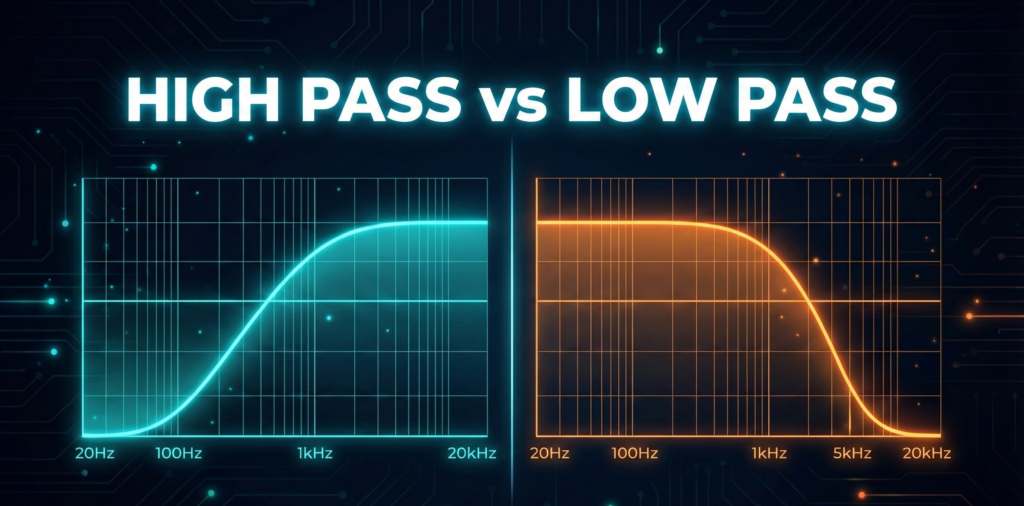
This region is strictly reserved for the kick drum and the primary bass instrument. If an atmospheric pad or a high-register arpeggio contains frequency content in this zone, it will cause severe phasing and headroom loss. Engineers must apply steep filtering. Understanding the nuances of a high-pass vs low-pass filter is critical here; a 24dB/octave high-pass filter set at 100Hz on all non-bass synthesizers instantly cleans up the low end of a track.
The Mud & Boxiness (200Hz – 500Hz)
The 250Hz to 400Hz range is where a mix is easily ruined. When playing complex chords on a polyphonic synthesizer, the frequencies in this band build up rapidly, resulting in a muffled, “boxy” sound. Engineers should apply a bell cut of -2.0 dB to -3.5 dB with a medium Q factor in this region to restore clarity to the overall instrumental.
The Body & Warmth (500Hz – 1kHz)
This is the fundamental core of most mid-range synthesizers. If a virtual analog synth sounds too thin, sterile, or “digital,” applying a gentle, wide boost around 800Hz will simulate the warmth associated with vintage hardware circuitry.
Bite, Presence & Aggression (2kHz – 5kHz)
The human ear is highly sensitive to the 2kHz – 5kHz range. If an industrial lead or a cyberpunk baseline needs to slice through heavy distorted guitars or aggressive cymbals, this is the target zone. A precise boost of +2.0 dB at 3.5kHz will push the synthesizer to the front of the mix.
Air, Sizzle & Width (8kHz+)
High frequencies dictate the perceived spatial width of an instrument. For cinematic textures, applying a smooth high-shelf boost starting at 8kHz adds a luxurious, expensive “air” to the signal. This mimics the high-frequency reflections of a massive physical acoustic space.
EQ Strategies for Specific Synth Types
Applying generic curves is insufficient; mixing synths requires adapting the equalization strategy to the specific role the patch plays in the arrangement.
Deep Synth Bass & 808s
When eqing synth bass, the priority is locking the lowest frequencies with the kick drum. The engineer must identify the root note of the bassline and find its fundamental frequency. If the bass is masking a vocal or a lead melody, a strategic cut should be made above 1kHz.
Cinematic & Ambient Pads
Because pads play sustained notes, analyzing synth pad eq frequencies is vital to prevent masking. Pads should act as a background environment. Therefore, they require aggressive high-pass filtering (150Hz) and a significant cut in the 300Hz range to ensure the snare drum and lead vocals remain unobstructed.
Aggressive Arps & Leads
Leads must capture the listener’s attention. Engineers should utilize high-pass filters up to 200Hz to remove unneeded body, followed by a slight boost in the 3kHz range. If the synthesizer relies heavily on a square wave, a narrow notch filter may be required around 4kHz to tame harsh, piercing resonances.
Pro Tips for Mixing Huge Synths
For advanced industrial and cinematic production, static equalization is often not enough. Engineers deploy specialized techniques to manage complex audio signals.
Use Dynamic EQ for Clashes
When a lead synthesizer and a vocal occupy the exact same frequency range (e.g., 2kHz), a static EQ cut will make the synth sound permanently thin. A dynamic EQ solves this by only attenuating the conflicting frequency when the competing instrument is actively playing.
Mid/Side Equalization
To make a synthesizer sound impossibly wide without causing phase cancellation in the low end, producers utilize Mid/Side processing.
Table 2: Mid/Side Synth EQ Strategy
| Channel Setting | Target Frequency | Action | Purpose |
| Mid (Center) | 20Hz – 150Hz | Leave untouched | Keeps the sub-bass anchored in mono. |
| Side (Stereo) | 20Hz – 150Hz | High-Pass Cut | Prevents phase issues and muddy stereo bass. |
| Side (Stereo) | 5kHz – 10kHz | High-Shelf Boost | Forces the high-frequency “air” out to the extreme left and right speakers. |
EQ Before or After Distortion?
The placement of the equalizer in the signal chain drastically alters the final timbre.
- Synth -> EQ -> Distortion: Cutting frequencies before distortion alters how the distortion engine reacts. Cutting low-end here results in a tighter, less muddy saturation.
- Synth -> Distortion -> EQ: Equalizing after distortion allows the engineer to tame the harsh new upper harmonics that the saturation plugin generated.
Conclusion
Navigating how to eq synthesizers effectively requires discipline and a subtractive mindset. Because virtual instruments deliver exceptionally rich and dense harmonic content, the engineer’s primary job is to carve away the excess. By utilizing this synth eq cheat sheet, meticulously filtering out low-end rumble from pads, managing the 300Hz mud, and employing strategic Mid/Side routing, producers can construct heavy, cinematic, and flawlessly balanced arrangements.
FAQ
Yes, as a general rule, any synthesizer that is not explicitly acting as the primary bass or sub-bass instrument should be high-passed. This removes inaudible low-frequency rumble that rapidly eats up master bus headroom and conflicts with the kick drum.
Synth pads often play complex, multi-note chords. The sum of these notes creates a massive buildup of resonant energy in the 200Hz – 500Hz frequency range. Applying a wide bell cut in this zone will immediately remove the “boxiness” and restore clarity to the mix.
Perceived width is heavily reliant on high frequencies. Applying a gentle high-shelf boost above 8kHz on the “Side” channel of a Mid/Side equalizer will force the brightest parts of the synthesizer to the extreme edges of the stereo field, creating a massive, cinematic sense of space.