EP vs LP: What Is the Difference? (Album vs. Extended Play Guide)
When an artist prepares to upload music to a distributor like DistroKid or TuneCore, they are immediately faced with a critical categorization question: “Is this release an EP or an Album?”
Making the wrong choice can confuse fans and mess up the discography layout on streaming platforms. In the modern era, EP or LP is not just a technical distinction regarding track counts; it is a marketing decision.
This story defines what ep means in the music industry, explores the history of the Long Play and Extended Play, and provides a strategic framework for deciding which format suits your career stage in 2026.
Introduction
To understand the difference between ep and lp, one must first look at the acronyms.
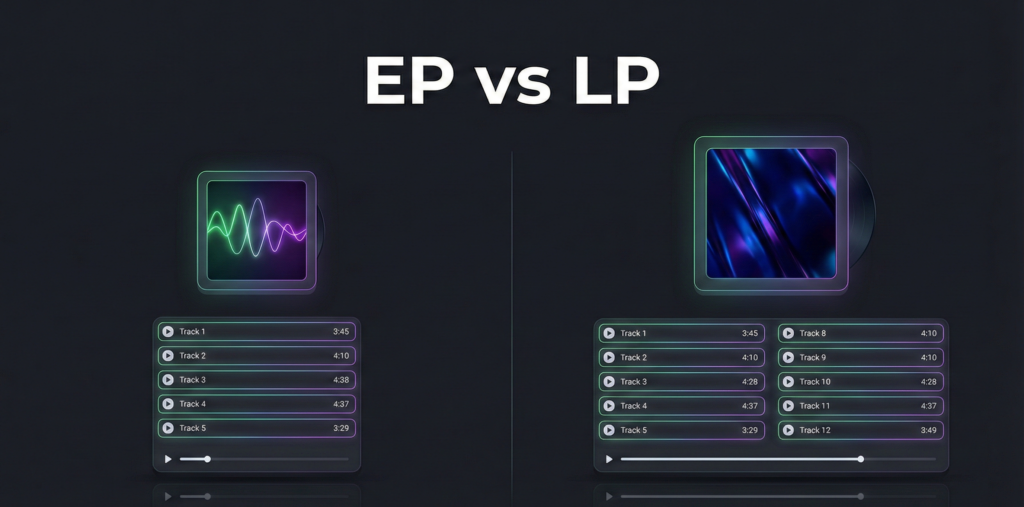
- EP (Extended Play): A musical recording that contains more music than a single but is too short to qualify as a full studio album.
- LP (Long Play): The traditional “Album.” A collection of songs intended to be viewed as a single artistic body of work.
Historically, what does LP mean in vinyl terms? It referred to a 12-inch phonograph record that spun at 33 ⅓ RPM, holding about 22 minutes of music per side. Today, in the digital age, the difference between an EP and a full album is defined by metadata rules set by Apple Music and Spotify.
What is an EP? (Definition & Criteria)
What does EP in music stand for? It stands for Extended Play. It acts as a middle ground between a single song and a heavy artistic statement.
Technical Criteria
For digital streaming platforms (DSPs), the technical meaning is:
- Track Count: Typically 4 to 6 tracks.
- Duration: Generally under 30 minutes.
- Apple Music Rule: If a release has 1-3 tracks, at least one track must be 10 minutes long or longer to be an EP. If it has 4-6 tracks, the total duration must be less than 30 minutes.
Why It Matters Visually
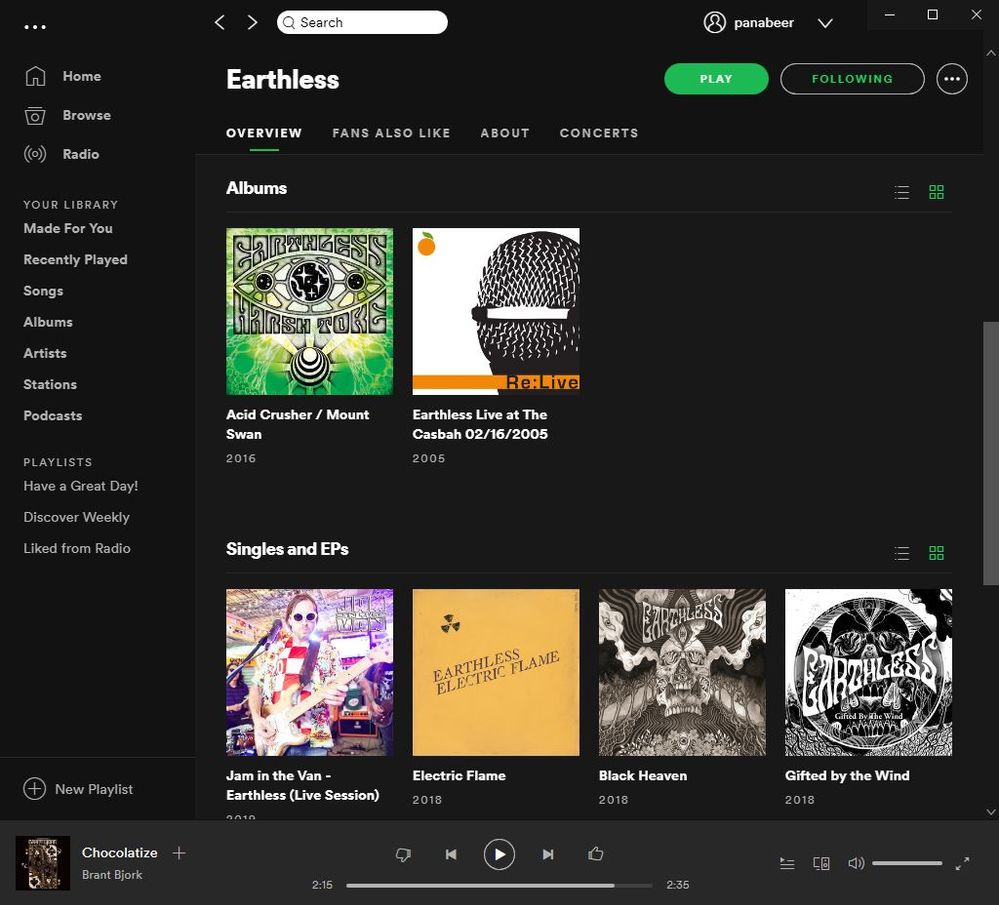
But how to classificate EP, for example, on Spotify? Where do I find all the necessary info in my profile? It places the release in a separate section called “EPs & Singles,” keeping your “Albums” section reserved for major releases. This visual distinction is crucial for discography management.
What is an LP? (Definition & Criteria)
What does LP stand for? It stands for Long Play. In the digital era, the terms “LP” and “Album” are often used interchangeably, though “LP” carries a more vintage, vinyl-centric connotation.
Technical Criteria
What is an lp according to distributors?
- Track Count: 7 tracks or more.
- Duration: 30 minutes or longer.
Important Note on Distributors: Services like DistroKid and TuneCore have automated sorting scripts. If you upload a project with 7 songs that are only 2 minutes each (14 minutes total), the system may still tag it as an Album/LP because the track count exceeds the EP threshold. You cannot force a 7-track project to be an EP on Apple Music; the system will override you.
The “Album” Concept
Long Play meaning goes beyond numbers. An LP is expected to have a “concept.” It often includes intro tracks, skits, and a cohesive narrative. It is the format used for professional reviews in magazines like Rolling Stone or Pitchfork.
The Strategic Choice: When Should You Release an EP?
Understanding what’s the difference between two distinct ways of publishing your music is only half the battle. The real question is: which one saves you money and gains listeners?
1. For New Artists (The “Business Card”)
Why should you go with an EP album? It’s especially important if you’re a new artist. It serves as a low-risk introduction. Producing 4 songs is significantly cheaper than producing 12. It allows you to enter the market quickly without the pressure of a debut album.
2. Testing the Waters
But what is the purpose of EP regarding your strategy? It means agility. You can release a 4-track EP experimenting with a new genre (e.g., Synthwave) to see how your audience reacts. If it flops, it was just an EP. If an LP flops, it can derail a career.
3. Frequency of Content
Streaming algorithms favor frequency. Releasing two EPs in one year (8 tracks total) often yields better results than releasing one LP (10 tracks) because it gives you two separate launch events and press cycles.
The Strategic Choice: When Should You Release an LP?
In its definition LP implies maturity and established demand. You should generally only release an LP when you have a fanbase waiting for it.
1. Touring Requirements
Promoters rarely book tours for artists with only 15 minutes of music. But how long should an LP be? Usually 45 minutes. This is exactly the length of a standard headline set at a small club. You need an LP to justify a tour.
2. Press and Critical Acclaim
Music critics rarely review EPs. They mostly prefer to listen to full length albums, in other words industry calls “Major Statement.” To get on “Best of the Year” lists or receive serious press coverage, you generally need a full-length album.
3. Merchandising
While people buy vinyl EPs, the vinyl’s value is much stronger in the physical market. Fans are more likely to spend $30 on a 12-inch heavyweight LP than on a short EP.
The “Waterfall Strategy” (Singles leading to EP/LP)
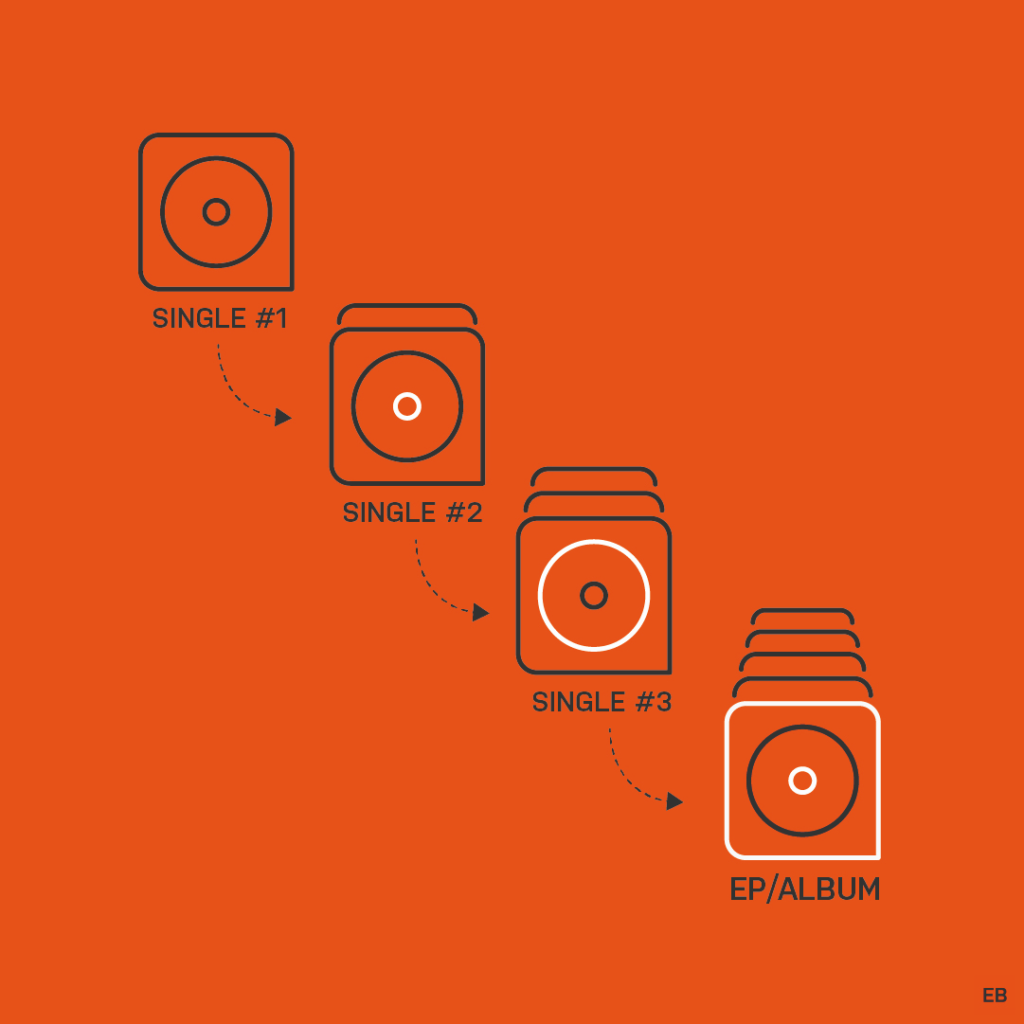
Historically, the smart money is on the “Waterfall Strategy.” This method blurs the line of difference between LP and EP release tactics.
Instead of dropping an album all at once, artists release tracks gradually:
- Single 1: Release Track A. Pitch to Spotify Editors.
- Single 2: Release Track B. Pitch to Editors.
- EP Release: Bundle Track A + Track B + 3 new songs into an EP.
This maximizes your chances of getting on editorial playlists. If you drop a 12-track LP record to drop it all at once, you can only pitch one song to Spotify editors. The other 11 tracks might go unnoticed.
Enjoyed this guide? Don’t miss other articles!
12/8 Time Signature – For those who want to extend their musical knowledge.
What is an 808 – Guide for beatmakers.
Comparison Table: Single vs. EP vs. LP
Here is a breakdown of single, EP and LP data.
| Feature | Single | EP (Extended Play) | LP (Long Play) |
| Track Count | 1 – 3 | 4 – 6 | 7+ |
| Duration | < 10 mins | < 30 mins | > 30 mins |
| Primary Goal | Awareness / Hype | Growth / Development | Legacy / Touring |
| Distributor Cost | Low | Medium | High (Production cost) |
| Spotify Tag | “Single” | “EP” | “Album” |
| Review Potential | Low | Low/Medium | High |
Conclusion
For 90% of independent artists, the EP is the superior format. It creates a “Business Card” for your sound without the immense financial and time burden of an album. Do not rush to define what does lp mean in music for your career until you have the audience size to support it. Start with singles, build into an EP, and earn the right to release your LP.
FAQ
The main difference between EP and LP is length. An EP is 4-6 tracks (under 30 mins), while an LP is 7+ tracks (over 30 mins). EPs are for building a fanbase; LPs are for established artists.
EP means Extended Play (Mini-Album). LP means Long Play (Full Album).
A standard EP contains 4 to 6 songs. If it goes over 6 songs, digital stores will usually reclassify it as an album.
EPs are cheaper to produce (fewer songs to mix/master). On iTunes, EPs are sold at a lower price point than LPs.
LP vinyl meaning refers to a 12-inch record spinning at 33 RPM. An EP on vinyl is often a 7-inch or 10-inch record spinning at 45 RPM.
In marketing it is a “tentpole” event used to launch merchandise lines, tours, and long-form reviews.