Understanding 12/8 Time Signature: The “Slow Rock” Groove Explained
Introduction: The “Hidden” Beat
Music theory often feels like mathematics, but some concepts are felt more than calculated. Have you ever listened to a song that seems to count to four, yet carries a rolling, swaying, or “waltz-like” quality that a standard pop beat lacks? You are likely hearing the 12/8 time signature.
This meter is the secret ingredient behind the soulful sway of Etta James, the driving arpeggios of R.E.M., and the swaying ballads of Ed Sheeran. It bridges the gap between a rigid march and a flowing dance. This guide breaks down what is 12/8 time signature, the theory of compound meter, and how to program a 12/8 metronome in a modern Digital Audio Workstation (DAW).
What exactly is 12/8 time signature
In standard Western music, the 4/4 time signature is king. It is a simple “1, 2, 3, 4” march. However, 4/4 can feel stiff. When a composer wants the stability of a four-beat measure but the emotion of a triplet feel, they turn to 12/8.
The Direct Answer: So, what is a 12/8 time signature? It is a “Compound Quadruple” meter. This means the measure is divided into four main beats, but each main beat is subdivided into three eighth notes rather than two.
- Top Number (12): There are twelve eighth notes in a single measure.
- Bottom Number (8): The eighth note gets the count.
This structure creates a rhythmic pattern of ONE-two-three, TWO-two-three, THREE-two-three, FOUR-two-three.
The Theory Behind 12/8 (Compound Meter)
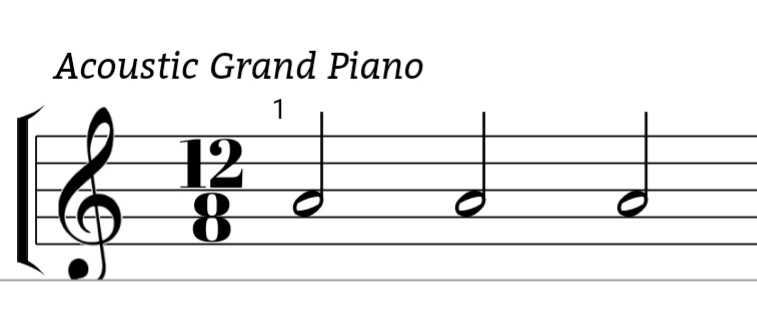
To master the 12/8 rhythm, one must understand the concept of “Compound Meter.”
In a simple meter (like 4/4), the beat divides into two (1 and, 2 and). In a compound meter (like 6/8 or 9/8), the beat divides into three. The 12/8 time signature is essentially four groups of triplets glued together.
Decoding the Numbers
When looking at sheet music, the numbers tell a specific story:
- 12: The numerator indicates the total number of subdivisions. You count twelve individual clicks before the bar repeats.
- 8: The denominator indicates that the eighth note is the unit of measurement.
What Gets the Beat in 12/8?
This is a common point of confusion. Technically, the eighth note gets the count. However, the listener does not tap their foot twelve times per bar—that would be frantic.
- The Pulse: The listener taps their foot four times per bar.
- The Beat Unit: The “dotted quarter note” (which equals three eighth notes) represents the main pulse.
Think of it like a nesting doll: The outer shell is a 4-beat measure. Inside each beat are three smaller notes.
How to Count in 12/8
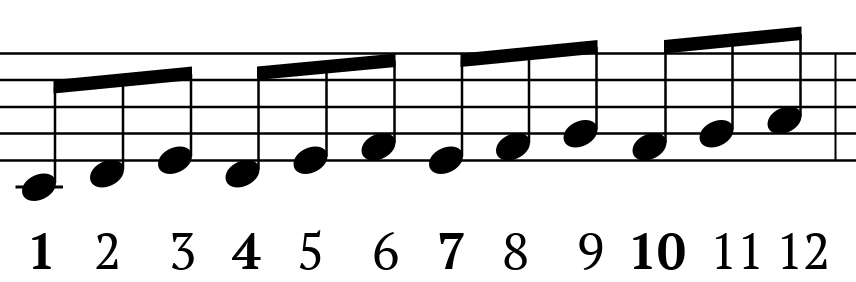
Learning how to count 12/8 is essential for drummers and conductors to maintain the groove without speeding up. There are two primary methods.
Method 1: The Subdivision Count (Slow Tempo)
For very slow ballads or when practicing complex fills, musicians count every single eighth note.
1 – 2 – 3 | 4 – 5 – 6 | 7 – 8 – 9 | 10 – 11 – 12
- Emphasis: Accents usually fall on 1, 4, 7, and 10.
Method 2: The Pulse Count (Standard Tempo)
This is the most common way to internalize the groove. You count the four main beats (Quadruple Meter) while articulating the triplets (Compound).
ONE – trip – let | TWO – trip – let | THREE – trip – let | FOUR – trip – let
or phonetically:
TA – ta – ta | TA – ta – ta | TA – ta – ta | TA – ta – ta
This method highlights what gets the beat in 12 8: the dotted quarter note pulse on the capitalized numbers.
12/8 vs. 4/4 with Triplets: What’s the Difference?
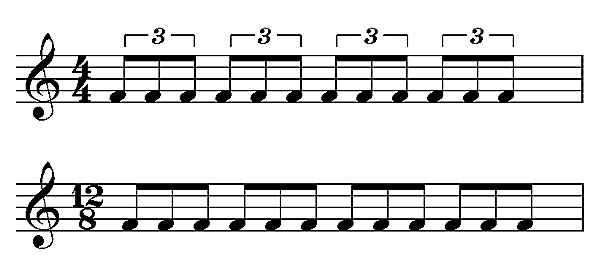
A frequent question in music theory is the difference between 12 8 and 4/4 time using triplets.
Mathematically, they are identical. A bar of 4/4 with triplets on every beat contains exactly 12 eighth notes, just like a bar of 12/8. However, the difference lies in notation and “default feel.”
1. Visual Cleanliness
- 4/4 with Triplets: The composer must write a “3” inside a bracket over every group of notes. If the whole song uses triplets, the sheet music becomes cluttered and difficult to read.
- 12/8: The notes are naturally grouped in threes using beams. No brackets are required. It is cleaner and signals to the musician immediately that the song has a rolling feel.
2. The “Shuffle” Implication
When a musician sees 4/4, they assume a “straight” feel (rock, march). When a musician sees 12/8 time signature, they assume a “shuffle” or “swing” feel (blues, doo-wop) by default.
Famous 12/8 Songs (Examples in Pop & Rock)
To fully understand the sway of this meter, one should listen to classic 12/8 songs.
- “Everybody Hurts” by R.E.M.
- This is the textbook example. The guitar arpeggio plays every single eighth note: 1-2-3-4-5-6. You can distinctly hear the 12 rhythm in the picking pattern.
- “At Last” by Etta James
- This represents the classic 1950s Doo-Wop/Soul ballad style. The drums and piano provide a heavy, romantic sway that is impossible to achieve in straight 4/4.
- “Perfect” by Ed Sheeran
- A modern example. While often mistaken for a waltz (3/4), the chord changes and drum backbeat reveal it to be 12 8. It feels like a waltz (1-2-3) happening four times in a row.
- “House of the Rising Sun” by The Animals
- Another guitar-arpeggio driven track where the 12/8 count drives the momentum of the song.
Stuck on a melody?
Don’t let writer’s block slow down your session. Use our free Chord Progression Generator to create emotional harmonies and complex voicings. A perfect starting point for your next track.
Setting Up a 12/8 Metronome in Your DAW
For producers, the default project setting is almost always 4/4. Trying to record a 12/8 song on a 4/4 grid will result in a chaotic, unsynchronized mess. Here is how to configure a 12/8 metronome properly.
Changing the Grid
In DAWs like Logic Pro, Cubase, or Pro Tools, locate the “Time Signature” or “Meter” display in the transport bar.
- Change the numerator to 12.
- Change the denominator to 8.
- Result: The grid lines will shift. Instead of 16 small boxes per bar (16th notes), you will see 12 boxes per bar (8th notes).
The Click Track Strategy
A standard metronome might click 12 times per bar, which is annoying at high speeds. To get the proper feel:
- Accent: Set the metronome to accent the first beat of every triplet group.
- Pattern: CLICK – click – click – CLICK – click – click.
- Kick & Snare: When programming drums, place the Kick on count 1 and the Snare on count 7 (which feels like the “3” in a standard backbeat).
Conclusion
The 12/8 time signature is the bridge between the rigidity of a march and the fluidity of a waltz. It allows musicians to count to four while moving in three. Whether you are playing a blues shuffle, a power ballad, or an Irish jig, understanding how to count in 12 8 unlocks a new tier of rhythmic expression.
It is not just about mathematics; it is about the “pocket.” The next time you hear a song that makes you want to sway side-to-side rather than bob your head up and down, you are likely enjoying the rolling motion of 12/8.
FAQ
No. While both are compound meters, the difference is the number of pulses. 6/8 has two main beats (ONE-trip-let, TWO-trip-let), dividing the measure in half. 12/8 has four main beats, making it twice as long and giving it a “common time” backbeat feel.
Yes, provided you subdivide the 4/4 beat into triplets. Many musicians count “1, 2, 3, 4” in their heads while feeling the triplet pulse underneath. This is how how to count 12/8 is effectively done in fast rock songs.
3/4 is a Simple Triple meter (Waitz) with three beats per measure (1-and, 2-and, 3-and). 12/8 is a Compound Quadruple meter with four beats. 3/4 feels like a triangle; 12/8 feels like a square made of triangles.
Listen to the Hi-Hats or the guitar strumming. If the underlying subdivision sounds like “One-and-a, Two-and-a” (groups of three) but the snare drum is hitting on a steady backbeat, it is likely a 12/8 time signature.
Composers use 12/8 when they want a cleaner score for triplet-heavy music. It avoids writing hundreds of “3” brackets over the notes, making the sheet music easier to read for the performer.